
The farm on the Klein River, then known as Kleine Riviers Valley, passed through several hands before Captain Robert Stanford bought it in 1838. After his fortunes collapsed, Philippus de Bruyn bought the farm in December 1855 and laid out a village of 200 erven on 123 hectares. The first plots were auctioned on 5 May 1856, and, as the story goes, the village was named Stanford after de Bruyn received £50 from Sir Robert to do so. Ninety-seven of the original erven had irrigation rights from the leiwater furrows, which still run through the streets today. The old farmhouse and mill were bought by Ephraim Moore, and his family lived there for more than a hundred years.
The full walk has 58 stops, marked by numbered tiles on the buildings. It starts at the Stanford Tourism Bureau on Queen Victoria Street. The eight highlights below are a short introduction; the booklet has them all, with a map to follow on foot.
Text by Bea and Basil Whittaker. Design and photographs by Maré Mouton. Map by Village Life. Published in October 2008 by the Stanford Heritage Committee.
This is the 2008 edition; some details have changed since then. Printed copies are available only from the Stanford Tourism Bureau.
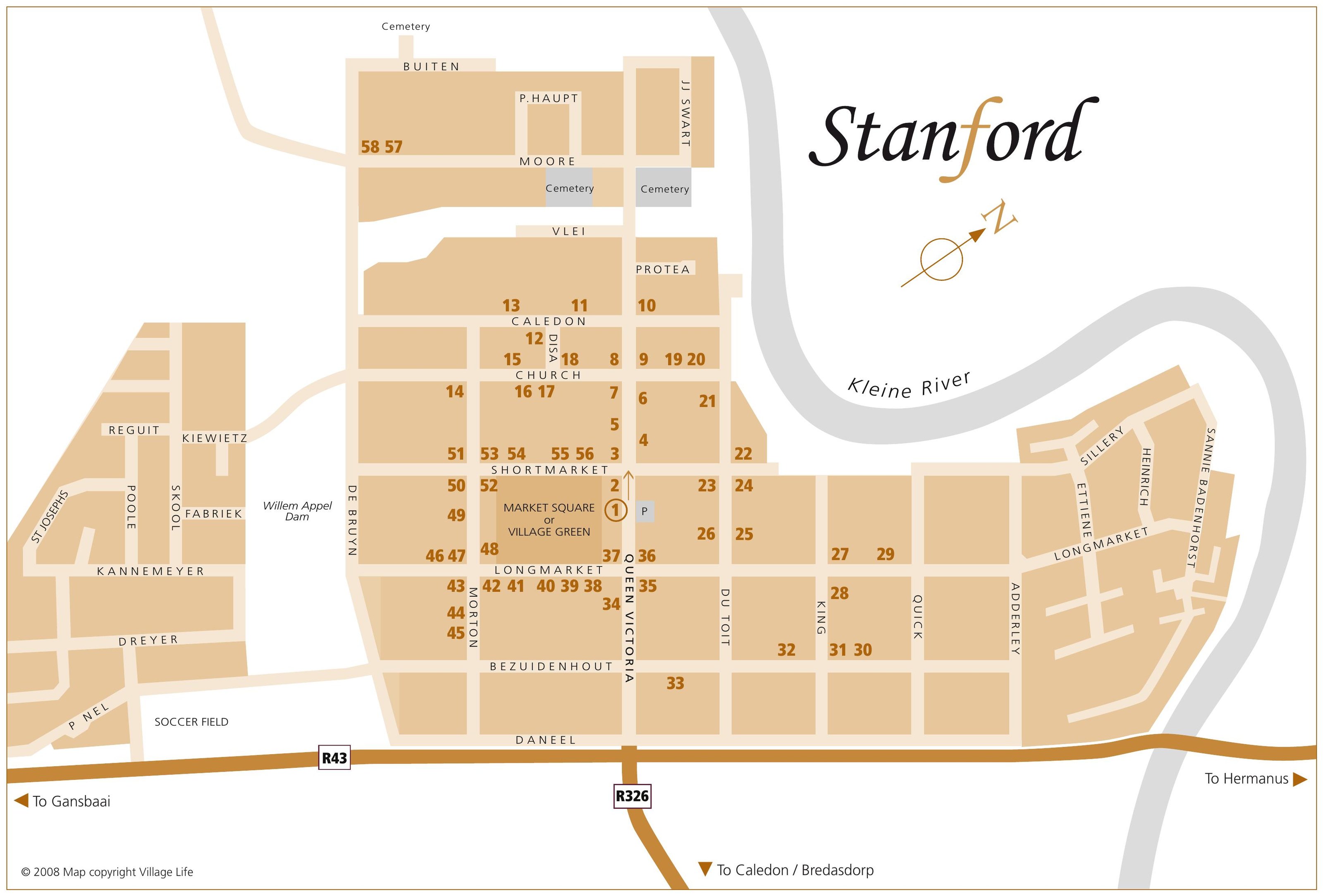
Highlight stops
HW 4 – Stanford Hotel (Erf 113, 1925)
This began as Kerneels Boucher's house and shop. In the 1930s it was enlarged and turned into a hotel, for many years the only lodging in the village after Granny Moore's boarding house closed. The old shop became the pub.
HW 7 – Dutch Reformed Church (1926)
The first church stood in the shape of a cross on the site of the present hall. The sandstone church was completed in 1926. The stone was quarried about 2 km south of the village, brought in by ox-wagon, and dressed by hand on the site. The cost, including the organ, clock and pews, was £12 000. In earlier years, when a well-known resident died, the church bells would first ring the person's age.
HW 8 – The old langhuis, Queen Victoria and Church Streets (Erf 77, late 1700s; extended around 1910)
This was built in the late 1700s as a long house and stables for the farmhouse (HW 18), and parts of it may be older than the house itself. In the 1920s it became a home, and was then extended along Church Street to hold the post office and the manual telephone exchange. The door on the diagonal is typical of the house-and-shop buildings of that time. This is the building on the booklet's front cover.
HW 13 – The mill (Erf 1189)
Behind the gate are the remains of the water mill built by Samuel Parlby and enlarged by Robert Stanford. The teak “dressing mill” was imported from Scotland, could grade four grades of wheat and could grind 24 bags a day. The grain went by ox-wagon to Stanford's Bay and then by sea to Cape Town. The mill stopped in the early 1940s; it later fell derelict and was dismantled, and only the building remains.
HW 18 – De Kleine Rivier Valey farmhouse (Erf 78)
Christoffel Brand built this farmhouse in the late 1700s. Lady Anne Barnard stayed here in 1798. Later owners included Sir John Truter, the first South African by birth to be knighted, and Sir Robert Stanford. Survivors of the troopship Birkenhead, wrecked off Danger Point on 26 February 1852, were given shelter here. The Moore family lived here until 1964. Ephraim Moore added a shop on the Church Street side and turned the house into a boarding house, run by his wife Polly, remembered as Granny Moore.
HW 39 – Wessel van Dyk's house (Erf 187, 1923)
Built in 1923 for Wessel van Dyk, the second mayor of Stanford, this is one of the finest eclectic villas of the village's heyday, and little of the exterior has changed. Van Dyk is remembered as the first person in Stanford to own a car. A water tank on the south side caught rainwater for the kitchen, so the house had water “on tap” before municipal water arrived in 1945.
HW 43 – Bugler's Cottage (Erf 394, 1800s)
This thatched cottage is named for the postman who brought the mail from Hermanus. When he crossed the Klein River bridge with his horse buggy, he blew a bugle to let the village know the post was coming. He was slightly lame, and was known as Hans Hinkepink. The low doors and the original thatch are typical of a simple late-1800s cottage.
HW 48 – St Thomas Anglican Church (building began 1863)
Building began in 1863. The Moore family carved some of the pews and the pulpit, and the thatch came from the area around the village. In 1892 the Bishop of Cape Town gave permission for weddings to be held in the chapel. There was no resident minister; the Anglican minister from Caledon served the church. The building next to it was the St Thomas Mission School, known as the Oulap School because each pupil paid one penny (oulap) a day. That building was still used as classrooms until 1983. The later restoration of the church and Oulap Hall is on our St Thomas Church & Oulap Hall page.
Photographs from Historical Stanford on foot. Photographs © 2008 Maré Mouton
HW 29 – Matilda May
During the apartheid years Matilda May was ordered to leave her home and move to Stanford South. She refused, and died there in the 1980s, as she had said she would. Only the foundations of the house remain; a street in Stanford is named after her.
The walk also passes the Market Square (Village Green), once used at nagmaal as a camping ground for families arriving by horse and ox-wagon, and later for sport. The booklet calls it one of the few remaining village squares in South Africa. See our Market Square page. The booklet also suggests a short drive to the old cemeteries in Moore Street (see The Forgotten Ones) and to the stone cottages at HW 57 and 58.
Stanford needs you.
Join for R400 per family a year, volunteer an hour or a skill, or make a donation.